

International Journal of Infection 2023; 7(2) May-August: 46-49
INHIBITION OF PI3Kβ AND mTOR INFLUENCE THE IMMUNE RESPONSE AND THE DEFENSE MECHANISM AGAINST PATHOGENS
Avivar-Valderas A. Inhibition of PI3Kβ and mTOR influence the immune response and the defense mechanism against pathogens. International Journal of Infection. 2023;7(2):46-49.
A. Avivar-Valderas*
Takeda, Cell Therapy Sciences, Madrid, Spain.
*Correspondence to:
Dr. Alvaro Avivar-Valderas,
Takeda, Cell Therapy Sciences,
Marconi 1, Tres Cantos,
28760 Madrid, Spain.
e-mail: Alvaro.avivar@takeda.com
| Received: 28 March, 2023 Accepted: 09 June, 2023
|
ISSN 1972-6945 [online] Copyright 2023 © by Biolife-publisher This publication and/or article is for individual use only and may not be further reproduced without written permission from the copyright holder. Unauthorized reproduction may result in financial and other penalties. Disclosure: all authors report no conflicts of interest relevant to this article. |

ABSTRACT
Phosphatidylinositol-4,5-bisphosphate 3-kinase catalytic subunit beta (PI3Kβ) and mechanistic target of rapamycin (mTOR) play crucial roles in various cellular functions, such as cell growth, survival, metabolism, immunity, and inflammation. The PI3Kβ gene encodes phosphoinositide 3-kinase (PI3K) and is a member of a family of lipid kinases, which are involved in cell proliferation, survival, and metabolism. PI3Kβ specifically phosphorylates phosphatidylinositol 4,5-bisphosphate (PIP2) to produce phosphatidylinositol 3,4,5-triphosphate (PIP3), which serves as a second messenger in various cell signaling pathways. PI3Kβ is ubiquitously expressed and is involved in neutrophil activation, immune, homeostatic, tumor, and infectious processes. Dysfunction of PI3Kβ can lead to excessive inflammatory responses or immunosuppression, and during sepsis, dysregulation of PI3Kβ can lead to exaggerated immune responses causing inflammation. PI3K can be an effective target against various diseases, including sepsis. mTOR is a protein kinase that phosphorylates serine and threonine and regulates various biological processes, including cell proliferation, mitochondrial activity, cell growth, survival, autophagy, and protein synthesis. mTOR interacts with both insulin production, as well as insulin-like growth factor (IGF)-1 and IGF-2, platelet-activating factor (PAF), and mitogens. The mTOR pathway is dysregulated in several diseases, particularly in some cancers and infections, and is inhibited by the immunosuppressant rapamycin. mTOR regulates metabolism and sepsis, and acts on the immune system by mediating T-cell activation and function. Targeting mTOR may be an effective method to improve immune responses and infectious states.
KEYWORDS: PI3Kβ, mTOR, immune response, pathogen, infection
INTRODUCTION
The phosphatidylinositol-4,5-bisphosphate 3-kinase catalytic subunit beta (PI3Kβ) and mechanistic target of rapamycin (mTOR) signaling pathways play an important role in regulating various cellular processes (1). They are involved in cell growth, survival, metabolism, and immune and inflammatory responses (2,3). PI3Kβ and mTOR may play critical roles in infections, inflammation, and sepsis, and their inhibition has significant implications in the context of many diseases (4).
DISCUSSION
The immune system acts as a sentinel in the human body to provide protection from infections. Failure of the immune system leads to the onset of various diseases including autoimmune diseases, cancer, inflammatory disorders, allergies, and compromised protection against infectious diseases (5).
PI3Kβ plays a key role in regulating the immune response and has been the subject of interesting scientific research in recent years (6). PI3Kβ is a gene encoding an isoform of the catalytic subunit of phosphoinositide 3-kinase (PI3K), is part of the PI3K/AKT signaling pathway, and is a crucial kinase in signaling pathways involving receptors on the outer membrane of eukaryotic cells (7). PI3Kβ is a family of lipid kinases and one of the class I PI3K isoforms that is involved in cellular proliferation, survival, and metabolism (8). PI3Kβ specifically phosphorylates phosphatidylinositol 4,5-bisphosphate (PIP2) to produce phosphatidylinositol 3,4,5-triphosphate (PIP3), which serves as a second messenger in various signaling pathways (9).
PI3Kβ is involved in the activation of neutrophils that have bound immune complexes at sites of inflammation and/or infection (10). It is expressed ubiquitously, mainly in certain cell types, such as platelets, immune cells, and in various organs (thyroid, kidney, etc.) and many other tissues. PI3Kβ is involved in some tumors and plays a role in regulating the activity of phagocytic cells (neutrophils and macrophages), which are important for fighting infections (11). The PI3Kβ pathway plays a critical role in various cellular processes, including immunity and the body’s response to infections and sepsis (Fig.1).
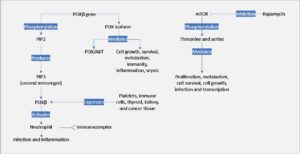
Fig. 1. The phosphorylation of PI3Kβ, expressed by platelets and other tissues, leads to the activation of the neutrophil immunocomplex, causing infection and inflammation. The PI3K isoform mediates cell growth, survival, metabolism, immunity, inflammation, and sepsis. The phosphorylation of mTOR, which can be inhibited by rapamycin, mediates cell proliferation, metabolism, survival, growth, and infection and transcription.
Sepsis is a life-threatening condition caused by an exaggerated immune response to infection, in which PI3Kβ is implicated in the regulation of inflammation and immune homeostasis (12). Dysfunction of PI3Kβ can lead to excessive inflammatory responses or immunosuppression, phenomena characteristic of sepsis. During sepsis, dysregulation of PI3Kβ can lead to exaggerated immune responses, contributing to systemic inflammation and tissue damage (13). PI3K has been reported as a potential modulatory target of the immune response in the therapy of sepsis (14,15). Advances have been made to better characterize PI3K and small, highly selective, and potent inhibitory molecules have been discovered, many of which are currently in clinical trials for the treatment of immune-related disorders and cancer (16).
mTOR, also called mammalian target of rapamycin, is a protein kinase that phosphorylates serine and threonine and regulates various biological processes such as cell proliferation, energy status, regulation of cell growth, motility and survival, metabolism, autophagy, protein synthesis, and cellular transcription (17). mTOR interacts with insulin production, insulin-like growth factor (IGF)-1 and IGF-2, platelet-activating factor (PAF), and mitogens (18).
mTOR regulates infection and sepsis by acting on the immune system and the mTOR pathway is dysregulated in diverse human diseases, particularly in some cancers and infections (19-22). Rapamycin is an immunosuppressant that can inhibit mTOR by binding to its intracellular receptor FKBP12 or cyclophilin A (23). mTOR is currently under investigation for its pharmacological inhibition as a means of suppressing tumor growth in different cancers including leukaemia, myelodysplasia, glioblastoma, and breast, liver, and pancreatic cancer (24,25). In addition to rapamycin, several specific experimental drugs that inhibit mTOR have been studied.
In infections, mTOR regulates immune cell metabolism, which is critical, as immune cells require energy to function properly. In particular, mTOR is important for the activation, differentiation, and function of T cells, which are essential for adaptive immune responses to pathogens. mTOR inhibits autophagy, which is important for eliminating intracellular pathogens including viruses and bacteria (26). During infection, inhibition of mTOR enhances autophagy and thus, infection. In sepsis, mTOR is often dysregulated, affecting the immune response and resulting in immunosuppression or inflammation, which are dangerous in severe infections (10). Targeting mTOR may potentially enhance immune and inflammatory responses in sepsis.
CONCLUSIONS
PI3Kβ plays a key role in infection and sepsis by regulating immune cell activation, phagocytosis, and cytokine generation. mTOR is implicated in immune cell metabolism, T cell activation, and autophagy, biological processes that influence acute and chronic infection. Dysregulation of mTOR can lead to hyperinflammatory and immunosuppressive states. Both PI3Kβ and mTOR represent potential targets for therapeutic intervention in infection and sepsis.
Conflict of interest
The author declares that they have no conflict of interest.
REFERENCES
- Xu W, Berning P, Erdmann T, et al. mTOR inhibition amplifies the anti-lymphoma effect of PI3Kβ/δ blockage in diffuse large B-cell lymphoma. Leukemia. 2022;37(1):178-189. doi:https://doi.org/10.1038/s41375-022-01749-0
- Kong D, Yamori T. Advances in Development of Phosphatidylinositol 3-Kinase Inhibitors. Current Medicinal Chemistry. 2009;16(22):2839-2854. doi:https://doi.org/10.2174/092986709788803222
- Gujrati H, Ha S, Mohamed A, Wang BD. MicroRNA-mRNA Regulatory Network Mediates Activation of mTOR and VEGF Signaling in African American Prostate Cancer. International Journal of Molecular Sciences. 2022;23(6):2926. doi:https://doi.org/10.3390/ijms23062926
- Becattini B, Breasson L, Sardi C, Zani F, Solinas G. PI3Kγ promotes obesity-associated hepatocellular carcinoma by regulating metabolism and inflammation. JHEP Reports. 2021;3(6):100359. doi:https://doi.org/10.1016/j.jhepr.2021.100359
- Wigerblad G, Kaplan MJ. Neutrophil extracellular traps in systemic autoimmune and autoinflammatory diseases. Nature Reviews Immunology. 2022;23(5):274-288. doi:https://doi.org/10.1038/s41577-022-00787-0
- Fruman DA, Chiu H, Hopkins BD, Bagrodia S, Cantley LC, Abraham RT. The PI3K Pathway in Human Disease. Cell. 2017;170(4):605-635. doi:https://doi.org/10.1016/j.cell.2017.07.029
- Yu L, Wei J, Liu P. Attacking the PI3K/Akt/mTOR signaling pathway for targeted therapeutic treatment in human cancer. Seminars in Cancer Biology. 2021;85:69-94. doi:https://doi.org/10.1016/j.semcancer.2021.06.019
- DeBerardinis RJ, Lum JJ, Hatzivassiliou G, Thompson CB. The Biology of Cancer: Metabolic Reprogramming Fuels Cell Growth and Proliferation. Cell Metabolism. 2008;7(1):11-20. doi:https://doi.org/10.1016/j.cmet.2007.10.002
- Carnero A, Paramio JM. The PTEN/PI3K/AKT Pathway in vivo, Cancer Mouse Models. Frontiers in Oncology. 2014;4. doi:https://doi.org/10.3389/fonc.2014.00252
- Pan T, Sun S, Chen Y, et al. Immune effects of PI3K/Akt/HIF-1α-regulated glycolysis in polymorphonuclear neutrophils during sepsis. Critical Care. 2022;26(1). doi:https://doi.org/10.1186/s13054-022-03893-6
- Niu N, Shen X, Zhang L, et al. Tumor Cell‐Intrinsic SETD2 Deficiency Reprograms Neutrophils to Foster Immune Escape in Pancreatic Tumorigenesis. Advanced Science. 2022;10(2). doi:https://doi.org/10.1002/advs.202202937
- Lopes-Pires ME, Naime ACA, Almeida Cardelli NJ, Anjos DJ, Antunes E, Marcondes S. PKC and AKT Modulate cGMP/PKG Signaling Pathway on Platelet Aggregation in Experimental Sepsis. Cox D, ed. PLOS ONE. 2015;10(9):e0137901. doi:https://doi.org/10.1371/journal.pone.0137901
- Cianciulli A, Porro C, Calvello R, Trotta T, Lofrumento DD, Panaro MA. Microglia Mediated Neuroinflammation: Focus on PI3K Modulation. Biomolecules. 2020;10(1):137. doi:https://doi.org/10.3390/biom10010137
- Zhang Z, Richmond A, Yan C. Immunomodulatory Properties of PI3K/AKT/mTOR and MAPK/MEK/ERK Inhibition Augment Response to Immune Checkpoint Blockade in Melanoma and Triple-Negative Breast Cancer. International Journal of Molecular Sciences. 2022;23(13):7353-7353. doi:https://doi.org/10.3390/ijms23137353
- Li X, Wei S, Niu S, et al. Network pharmacology prediction and molecular docking-based strategy to explore the potential mechanism of Huanglian Jiedu Decoction against sepsis. Computers in Biology and Medicine. 2022;144:105389. doi:https://doi.org/10.1016/j.compbiomed.2022.105389
- Liu S, Ma H, Zhang H, Deng C, Xin P. Recent advances on signaling pathways and their inhibitors in rheumatoid arthritis. Clinical Immunology. 2021;230:108793. doi:https://doi.org/10.1016/j.clim.2021.108793
- Saxton RA, Sabatini DM. mTOR Signaling in Growth, Metabolism, and Disease. Cell. 2017;168(6):960-976. doi:https://doi.org/10.1016/j.cell.2017.02.004
- Schakman O, Kalista S, Barbé C, Loumaye A, Thissen JP. Glucocorticoid-induced skeletal muscle atrophy. The International Journal of Biochemistry & Cell Biology. 2013;45(10):2163-2172. doi:https://doi.org/10.1016/j.biocel.2013.05.036
- Cheng SC ., Quintin J, Cramer RA, et al. mTOR- and HIF-1 -mediated aerobic glycolysis as metabolic basis for trained immunity. Science. 2014;345(6204):1250684-1250684. doi:https://doi.org/10.1126/science.1250684
- Pópulo H, Lopes JM, Soares P. The mTOR Signalling Pathway in Human Cancer. International Journal of Molecular Sciences. 2012;13(2):1886-1918. doi:https://doi.org/10.3390/ijms13021886
- Anuradha Kirtonia, Pandey AK, Ramachandran B, et al. Overexpression of laminin-5 gamma-2 promotes tumorigenesis of pancreatic ductal adenocarcinoma through EGFR/ERK1/2/AKT/mTOR cascade. Cellular and Molecular Life Sciences. 2022;79(7). doi:https://doi.org/10.1007/s00018-022-04392-1
- Rashidi S, Mansouri R, Ali-Hassanzadeh M, et al. The host mTOR pathway and parasitic diseases pathogenesis. Parasitology Research. 2021;120(4):1151-1166. doi:https://doi.org/10.1007/s00436-021-07070-6
- Chen J, Fang Y. A novel pathway regulating the mammalian target of rapamycin (mTOR) signaling. Biochemical Pharmacology. 2002;64(7):1071-1077. doi:https://doi.org/10.1016/s0006-2952(02)01263-7
- Magaway C, Kim E, Jacinto E. Targeting mTOR and Metabolism in Cancer: Lessons and Innovations. Cells. 2019;8(12):1584. doi:https://doi.org/10.3390/cells8121584
- Benjamin D, Colombi M, Moroni C, Hall MN. Rapamycin passes the torch: a new generation of mTOR inhibitors. Nature Reviews Drug Discovery. 2011;10(11):868-880. doi:https://doi.org/10.1038/nrd3531
- Larabi A, Barnich N, Nguyen HTT. New insights into the interplay between autophagy, gut microbiota and inflammatory responses in IBD. Autophagy. 2019;16(1):38-51. doi:https://doi.org/10.1080/15548627.2019.1635384