

International Journal of Infection 2023; 7(1) January-April: 18-22
INFECTIONS AND AUTOIMMUNITY: FOCUSING ON SKIN DISORDERS
Tetè G. Infections and autoimmunity: Focusing on skin disorders. International Journal of Infection. 2023;7(1):18-22.
G. Tetè*
Department of Dentistry, Vita-Salute San Raffaele Hospital, Milan, Italy.
*Correspondence to:
Giulia Tetè,
Department of Dentistry,
Vita-Salute San Raffaele Hospital,
Milan, Italy.
e-mail: tetegiulia92@gmail.com
| Received: 16 January, 2023 Accepted: 03 April, 2023
|
ISSN 1972-6945 [online] Copyright 2023 © by Biolife-publisher This publication and/or article is for individual use only and may not be further reproduced without written permission from the copyright holder. Unauthorized reproduction may result in financial and other penalties. Disclosure: all authors report no conflicts of interest relevant to this article. |

ABSTRACT
The incidence of autoimmune diseases has been increasing, and microbial infection can trigger the onset of these diseases. Viruses can cause an excessive immune response directed against both foreign and self-antigens, which can either enhance or worsen the pathological state of autoimmune diseases. Erythema multiforme (EM) is an inflammatory autoimmune disease caused by different antigens which affects the skin and mucous membranes. It has been observed that some viral diseases can protect or aggravate the autoimmune state. For example, viruses can inhibit tolerance by developing responses against autoantigens. In addition, complement dysregulation due to viruses can lead to immune damage with autoimmune phenomena. Atopic dermatitis is a disease that affects the skin in childhood and is characterized by activation of immune cells, chronic inflammation and eczematous disorders. Eczematous skin overexpresses FceRI receptors that bind IgE, an effect that causes lesions and disrupts the epidermal barrier. In the allergic reaction, there is activation of naïve T cells that produce IL-4 and TH2 cells that generate IL-5. EM affects the skin and causes blisters and ulcers that can appear all over the trunk. In autoimmune allergic skin diseases, there is activation of TLR-7 with vasculitis, skin mucus production, inflammation, and toxic necrosis. In experimental dogs, autoimmunity can present with hair loss and inflammatory patches on the face and trunk with the presence of pemphigus foliaceus that manifests with pustules, erosions, crusts, ulcers and scars. To date, the mechanisms of autoimmunity are still unknown and intensive studies will needed to clarify the advent of this disease that causes concern in our society.
KEYWORDS: Infection, autoimmune disease, erythema multiforme, atopic dermatitis, inflammation
INTRODUCTION
In contemporary society, particularly in industrialized countries, allergic and autoimmune diseases have significantly increased, a phenomenon which has created concern (1). In industrialized countries, autoimmune diseases are the third most widespread cause of mortality, and the pathogenesis still remains mysterious (2).
Infection by microorganisms may be a primary factor triggering the onset of autoimmune disease (3) (Fig.1). Microbial infection, particularly with viruses, can cause an excessive immune response directed against both foreign and self-antigens (4). Viruses can either enhance or worsen the pathological state of autoimmune diseases.
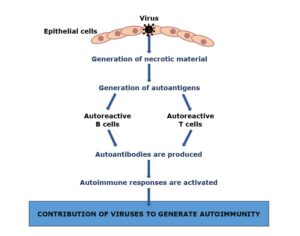
Fig. 1. Viruses bind epithelial cell receptors mediate the generation of necrotic material and the formation of autoantigens which activate the immune response with the generation of autoreactive B and T cells. This causes autoantibodies to be produced, which causes autoimmune responses.
Erythema multiforme (EM) is an inflammatory autoimmune disorder affecting the skin and mucous membranes. It is a cyclical hypersensitivity reaction caused by different antigens. Another autoimmune disease affecting the skin is atopic dermatitis (AD) (atopic eczema), which has a complex pathogenesis that is still being explored. In AD, there are increased IgE antibodies and an imbalance of inflammatory cytokines.
DISCUSSION
In autoimmune diseases, virus infection can either protect or aggravate the pathological state, depending on the genetic aspects of the host organism. Viruses can aggravate autoimmunity through various mechanisms. They can infect B cells to become immortal, and engage in molecular mimicry, in which microbial or environmental antigens bear structural similarity to autoantigens, leading to cross-reactivity and subsequent production of autoantibodies. Viruses also spread epitopes to recruit self-reactive lymphocytes against normally tolerated host antigens, which contributes to the chronicity of disease. Furthermore, viruses can break tolerance with the development of responses against self-antigens and the onset of autoimmune diseases. On the contrary, the pathological state of autoimmune diseases can improve by viral stimulation of the immune system. Furthermore, inflammatory autoimmune diseases, such as rheumatic and musculoskeletal disorders and systemic lupus erythematosus, are mediated by innate immune cells and inflammasomes that can be activated by viral infections (5).
Complement is very important for the immune response against infections and a dysregulation of this protein can damage immune and inflammatory defences and lead to autoimmunity (6). Basophilic, eosinophilic, and mast cell granulocytes protect the host from helminth infections, but they also act as inhibitors of allergic phenomena (7).
AD is a dermatological disorder that begins in childhood and is characterized by chronic inflammation of the skin (8). The disorder presents lesions of the skin and itching and affected subjects that have a greater risk of contracting allergies, asthma, and other immune and inflammatory diseases, with possible effects on the central nervous system (CNS) (9). In AD, the immune system is altered with an increased response of TH2 cells to allergens which causes an exaggerated production of IgE antibodies (10). AD is a relapsing disease with a rapid and chronic course that is characterized by autoreactivity mediated by IgE, and so therefore, it is defined as an autoallergy (11). However, the mediation of IgE in hypersensitivity and eczematous disorders is still unclear. Corticosteroid is most widely used therapy for AD, and, in severe cases, non-specific immunosuppressive drugs are also used (12).
In the skin, IgE Langerhans cells bind FceRI receptors, which are more abundantly expressed in eczematous AD lesions (13). The skin is a very important protective organ and constitutes an epidermal barrier. When it is damaged, the body is more predisposed to allergic and autoimmune diseases, such as asthma and AD (14).
In the initial phase of allergic skin reactions, the antigen binds its receptor on macrophages which generates IL-18. This reaction activates naïve T cells to produce IL-4 and TH2 cells to generate IL-5 (15). IL-5 activates eosinophils to produce further cytokines, including GM-CSF and IL-3, which participate in the allergic response.
EM is an inflammatory autoimmune skin disorder that begins as in acute form and can be recurrent or persistent. It is often caused by certain drugs used in therapy, or by infection with the herpes simplex virus or Mycoplasma pneumoniae (16).
EM affects the skin and mucous membranes and manifests itself with blisters and ulcers that can appear all over the trunk. EM occurs cyclically as a hypersensitivity reaction caused by various antigens and is classified according to clinical severity (17). EM can occur as minor or major and its diagnosis is sometimes confused with other disorders that present similar clinical characteristics. A strong genetic predisposition and exposure to UV light has been linked to EM, which can appear a few years after birth (18). In this skin diseases, there may be toxic necrosis of the epidermis with vasculitis. EM may present vascular cutaneous erythematosus, cutaneous mucus, and inflammation, which are mediated by toll-like receptor (TLR)-7 (19). In fact, in autoimmune diseases it has been seen that there is an aggravation of plaque in psoriasis when TLR-7 is blocked.
It has been observed that autoimmune phenomena in certain mammals such as dogs can predominantly affect certain parts of the body, causing hair loss and inflammatory patches in the muzzles and trunks of the animals (20). The pathological state can also be concentrated on both the front and rear legs. Immunological dysfunctions in these animals can trigger pemphigus foliaceus with both histological and clinical pathological characteristics (21).
Pemphigus foliaceus occurs with pustules, erosions, crusts, ulcers, and scars. At the level of the primary lesions, there may be flaccid vesicles which are easy to break, and the histological tissue may also present with soprobasal acantholysis with cleft formation and basal cells remaining at the base (row of tombstones). In dogs, penphigus vulgaris can have a spontaneous remission (3%), a partial remission (30%), or a complete remission (65%), after treatment with prednisolone or dexamethasone at a dose of 3-4 mg/kg of weight body (22). AD can also affect cats with lesions concentrated on the face and ears.
In these animals, alopecia is often treated not only at a pharmacological level, but also with mechanical stimulation through a small roller with needles which functions by sliding over the skin where hair is lacking. After a few months of this treatment, the hair bulb can be reactivated, and the presence of hair can be restored.
Vitamins play an important role in protecting the body against infectious pathogens while also reducing the risk of autoimmunity (23). Low levels of vitamins A, D, C, and E increase vulnerability to infections and the development of autoimmunity. Anti-viral vaccines are under investigation for the prevention or containment of autoimmune states. So far, there have been promising results, however these vaccines are still in the experimental phase (24).
In general, a better knowledge of the pathogenesis of autoimmune skin diseases, and of autoimmunity in general, could help in the development of new therapies to treat these disorders.
CONCLUSIONS
EM and AD are both inflammatory autoimmune skin diseases. EM is a cyclical hypersensitivity reaction caused by different antigens which results in the appearance of blisters and ulcers covering the trunk of the body. AD is a complex disease characterized by immune dysfunction and chronic inflammation of the epidermis. The pathogenesis is still unclear; however it involves immune cell dysregulation with an imbalance of inflammatory cytokines ranging from TH2 to TH1, and a marked hypersensitivity to IgE antibodies which are increased.
Conflict of interest
The author declares that they have no conflict of interest.
REFERENCES
- Haanen J, Ernstoff MS, Wang Y, et al. Autoimmune diseases and immune-checkpoint inhibitors for cancer therapy: review of the literature and personalized risk-based prevention strategy. Annals of Oncology. 2020;31(6):724-744. doi:https://doi.org/10.1016/j.annonc.2020.03.285
- Rose NR. Prediction and Prevention of Autoimmune Disease in the 21st Century: A Review and Preview. American Journal of Epidemiology. 2016;183(5):403-406. doi:https://doi.org/10.1093/aje/kwv292
- De Luca F, Shoenfeld Y. The microbiome in autoimmune diseases. Clinical & Experimental Immunology. 2018;195(1):74-85. doi:https://doi.org/10.1111/cei.13158
- Schattner A, Bracha Rager-Zisman. Virus-Induced Autoimmunity. Reviews of Infectious Diseases. 1990;12(2):204-222. doi:https://doi.org/10.1093/clinids/12.2.204
- Szekanecz Z, McInnes IB, Schett G, Szamosi S, Benkő S, Szűcs G. Autoinflammation and autoimmunity across rheumatic and musculoskeletal diseases. Nature Reviews Rheumatology. 2021;17(10):585-595. doi:https://doi.org/10.1038/s41584-021-00652-9
- Conigliaro P, Triggianese P, Ballanti E, Perricone C, Perricone R, Chimenti MS. Complement, infection, and autoimmunity. Current Opinion in Rheumatology. 2019;31(5):532-541. doi:https://doi.org/10.1097/bor.0000000000000633
- Kolkhir P, Muñoz M, Asero R, et al. Autoimmune chronic spontaneous urticaria. Journal of Allergy and Clinical Immunology. 2022;149(6):1819-1831. doi:https://doi.org/10.1016/j.jaci.2022.04.010
- Noma T. Helper T cell paradigm : Th17 and regulatory T cells involved in autoimmune inflammatory disorders, pathogen defense and allergic diseases. Nihon Rinshō Men’eki Gakkai kaishi/Nihon Rinshou Men’eki Gakkai kaishi. 2010;33(5):262-271. doi:https://doi.org/10.2177/jsci.33.262
- Matyszak M. Inflammation in the CNS: balance between immunological privilege and immune responses. Progress in Neurobiology. 1998;56(1):19-35. doi:https://doi.org/10.1016/s0301-0082(98)00014-8
- Bieber T. Atopic Dermatitis. New England Journal of Medicine. 2008;358(14):1483-1494. doi:https://doi.org/10.1056/nejmra074081
- De Bruyn Carlier T, Badloe FMS, Ring J, Gutermuth J, Kortekaas Krohn I. Autoreactive T cells and their role in atopic dermatitis. Journal of Autoimmunity. 2021;120:102634. doi:https://doi.org/10.1016/j.jaut.2021.102634
- Huang X, Wu H, Lu Q. The Mechanisms and Applications of T Cell Vaccination for Autoimmune Diseases: a Comprehensive Review. Clinical Reviews in Allergy & Immunology. 2014;47(2):219-233. doi:https://doi.org/10.1007/s12016-014-8439-6
- Ring J, Darsow U, Behrendt H. Atopic eczema and allergy. Current Allergy and Asthma Reports. 2001;1(1):39-43. doi:https://doi.org/10.1007/s11882-001-0095-2
- Egami S, Yamagami J, Amagai M. Autoimmune bullous skin diseases, pemphigus and pemphigoid. Journal of Allergy and Clinical Immunology. 2020;145(4):1031-1047. doi:https://doi.org/10.1016/j.jaci.2020.02.013
- Sanders NL, Mishra A. Role of interleukin-18 in the pathophysiology of allergic diseases. Cytokine & Growth Factor Reviews. 2016;32:31-39. doi:https://doi.org/10.1016/j.cytogfr.2016.07.001
- Berentsen S. New Insights in the Pathogenesis and Therapy of Cold Agglutinin-Mediated Autoimmune Hemolytic Anemia. Frontiers in Immunology. 2020;11. doi:https://doi.org/10.3389/fimmu.2020.00590
- Tomasini C, F Derlino, Quaglino P, Caproni M, G Borroni. From erythema multiforme to toxic epidermal necrolysis. Same spectrum or different diseases? Giornale italiano di dermatologia e venereologia. 2014;149(2):243-261.
- Avci P, Gupta A, Sadasivam M, et al. Low-level laser (light) therapy (LLLT) in skin: stimulating, healing, restoring. Seminars in cutaneous medicine and surgery. 2013;32(1):41-52.
- Fetter T, Niebel D, Braegelmann C, Wenzel J. Skin-Associated B Cells in the Pathogenesis of Cutaneous Autoimmune Diseases—Implications for Therapeutic Approaches. Cells. 2020;9(12):2627. doi:https://doi.org/10.3390/cells9122627
- Wm P. Autoimmune skin diseases in the dog. The Canadian veterinary journal = La revue vétérinaire canadienne. 1981;22(10):302-304.
- Robledo MA. Chronic methyl mercury poisoning may trigger endemic pemphigus foliaceus “fogo selvagem.” Medical Hypotheses. 2012;78(1):60-66. doi:https://doi.org/10.1016/j.mehy.2011.09.041
- Tham HL, Linder KE, Olivry T. Deep pemphigus (pemphigus vulgaris, pemphigus vegetans and paraneoplastic pemphigus) in dogs, cats and horses: a comprehensive review. BMC Veterinary Research. 2020;16(1). doi:https://doi.org/10.1186/s12917-020-02677-w
- Charoenngam N, Holick MF. Immunologic Effects of Vitamin D on Human Health and Disease. Nutrients. 2020;12(7):2097. doi:https://doi.org/10.3390/nu12072097
- Ostrov BE, Amsterdam D. Interplay of Anti-Viral Vaccines with Biologic Agents and Immunomodulators in Individuals with Autoimmune and Autoinflammatory Diseases. Immunological Investigations. 2021;50(7):833-856. doi:https://doi.org/10.1080/08820139.2021.1900863